

Totem Poles in British Columbia: Where to See Them & Indigenous Stays

British Columbia is one of the best places in the world to experience totem poles, not as photo props or roadside attractions, but as living cultural expressions that tell stories of family, history, and connection to the land.
If you’ve travelled around BC, you’ve likely seen totem poles in parks, cultural centres, museums, and even small communities. But understanding where they come from, what they represent, and who they belong to adds a much deeper layer to the experience.
This guide explores where to see totem poles in British Columbia, what they mean, and how you can travel more intentionally by supporting Indigenous-owned accommodations and Indigenous food experiences along the way.
What Totem Poles Represent
Totem poles are carved by Indigenous Nations of the Pacific Northwest Coast, particularly the Haida, Tlingit, Tsimshian, Kwakwaka’wakw, Coast Salish, and Nuu-chah-nulth peoples. They are not objects of worship, and they are not used by all Indigenous Nations across Canada.
Instead, totem poles are visual storytellers.
They may represent:
- Family lineage and ancestry
- Clan crests and animals
- Memorials for loved ones
- Welcome poles greeting visitors
- Significant historical events or teachings
Figures are typically stacked vertically and read from bottom to top, though interpretations can vary depending on Nation and carver. Animals such as raven, eagle, bear, wolf, and frog are common, each carrying specific meanings tied to stories and teachings.
You’ll also notice that some poles are left to weather naturally over time. This is intentional… a reflection of life cycles, impermanence, and respect for nature.
Understanding this context transforms a casual stop into something far more meaningful.
In this post, I am highlighting just a few totem poles of British Columbia… there are so many more, each with a distinct story to tell, and I want to see as many as I can. As I visit new places, I’ll add more to this list and replace any stock images with my own.
Most of the totem poles I mention below are in the Lower Mainland and on Vancouver Island, but there are many more throughout BC. When I was in my teens, I visited Ksan Village and watched a master carver create a new totem pole. I would love to drive north again and see all of this with fresh eyes. Please comment below and let me know which ones you’ve seen that I need to visit.
British Columbia is home to Métis and more than 200 distinct First Nations…
indigenoustourism.ca
one-third of all the Indigenous people in Canada.
Where to See Totem Poles in British Columbia
Vancouver Airport
Totem poles and Aboriginal carvings are scattered throughout the YVR airport, particularly inside the terminal. These incredible works of art add to visitors’ travel experience. If you have a layover, use it as an opportunity to take a self-guided tour and check out the airport’s totem poles before sightseeing in the city. I keep meaning to take photos of them as I travel through… one day I will!
Stanley Park, Vancouver
The totem poles at Brockton Point in Stanley Park are among the most visited cultural sites in British Columbia. Originally erected in the 1920s, these poles represent several Indigenous Nations from across the coast.
While many visitors see this as a quick stop, it’s worth slowing down. Interpretive signage explains the origins of each pole, and the surrounding area offers views of Burrard Inlet, the North Shore Mountains, and Vancouver Harbour.
Travel tip: Visit early in the morning or later in the evening for fewer crowds and better light.
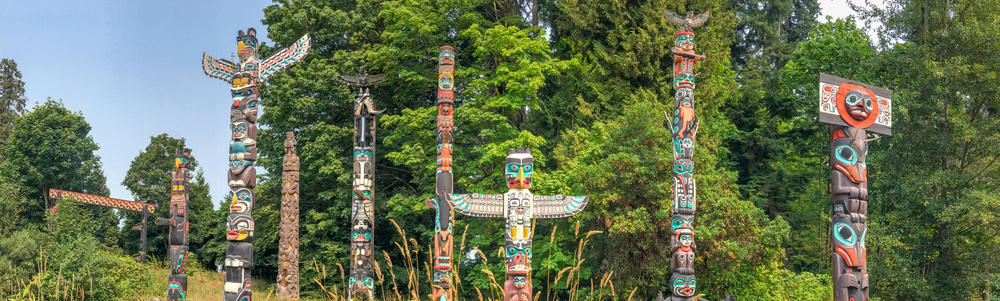
Capilano Suspension Bridge
Most people visit Capilano Suspension Bridge for the bridge itself, but the totem poles here deserve far more attention than they usually get.
Tucked into the forested areas of the park, you’ll find a collection of Coast Salish–style totem poles set against towering trees and canyon views. It’s a beautiful setting, and one that naturally encourages you to pause and look more closely.
What I appreciate about this stop is that it often surprises people. You come for the bridge, but you leave having learned something about Coast Salish culture, especially if you take the time to read the interpretive signs and understand the Nations connected to the land.
If you’re already visiting Capilano, treat the totem poles as part of the experience, not an afterthought. This is a good example of how cultural learning can be woven into popular attractions, if we let it be.
White Rock
Totem Park is a great place to check out historic totem poles. This park is centrally located along the promenade at White Rock Beach as a tribute to the Semiahmoo First Nation, as it rests on their land. Totem Park is also known as Chief Bernard Memorial Plaza. Within this area, you can stroll the promenade, visit the White Rock Museum or even relax on the beach. You can take it up a notch and go on a sea tour or whale-watching activity.
Stay somewhere central in Vancouver, so you can explore the entire region over a few days.
Victoria (Vancouver Island)
Established in 1941, Thunderbird Park in Victoria has a display of totem poles from the provincial museum’s collection. Additionally, there is a wide range of things to see and do right there. For instance, there are many guided tours, as well as beaches and lakes, gardens and parks, cathedrals, and museums. The activities are endless within this location.
If you want to truly understand what you’re seeing elsewhere in British Columbia, the First Peoples Gallery at the Royal BC Museum is one of the best places to start. Inside, you’ll find massive house posts and poles displayed in a way that reflects how they would traditionally exist within longhouses, not as isolated objects, but as part of a lived environment. The gallery also provides essential historical and contemporary context around Indigenous cultures in BC, including language, land, and continuity.
What makes this museum especially valuable is how it bridges past and present. Totem poles here aren’t framed as artifacts from a vanished time, they’re presented as part of cultures that are very much alive today.
If you’re visiting Victoria, I always recommend pairing this with time at Thunderbird Park just outside. Together, they offer one of the most complete introductions to Indigenous cultures in the province.
Beacon Hill Park in Victoria is home to what was once the tallest totem pole in the world, standing at 38.9 metres (128 feet). However, it is now the fourth-tallest pole worldwide.
You can also find totem poles within Butchart Gardens. I can easily spend a day walking through the beautiful gardens any time of the year.
There are many places to stay in Victoria, and I recommend staying near the Inner Harbour. There’s so much to explore just in this area. I have a full YouTube video on things to do.
Duncan (Vancouver Island)
This small city on Vancouver Island has the most totem poles I have personally seen in one location, and is aptly designated “The City of Totems”. Visitors can take a walking tour and see these works of art close up. The photo for this article is one of many from Duncan.
Alert Bay (Vancouver Island)
The world’s largest 173-foot-tall wooden totem pole can be found in Alert Bay on the north section of Vancouver Island. It is demonstrably the tallest totem pole of its kind globally. While in Alert Bay, get in the mood for its culture and history and visit the galleries, public library and museum and the Namgis Original Burial grounds. Though visitors are not allowed on this burial ground, the memorial totem poles are visible from the road.
If you’re going to explore more of Vancouver Island beyond the Victoria area, I recommend staying somewhere more central, such as Nanaimo. You can even stay in a few different places, like Tofino & Ucluelet, because you’ll want to spend more time in this region! Use the map below to scroll around, zoom in and out, and find places to stay!
Haida Gwaii (previously known as the Queen Charlotte Islands)
Totem poles in Haida Gwaii represent the rich history of the Haida Nation. The best way to visit is on a guided tour. If you’d like a custom quote, please reach out to me. The largest grouping is found in the ancient village of Ninstints. Totem poles are also within other ancient village sites, including Hotspring Island, which has been designated a UNESCO World Heritage Site and is a favourite stop for kayakers around the southern region of the archipelago. Haida Gwaii’s totem poles are also evident outside Skidegate in Kaay Llnangaay at the Haida Heritage Centre.
In Haida Gwaii, you can experience its beautiful beaches, forests, wildlife, and, of course, the Pacific Ocean. You can hit the hiking trails and absorb the breathtaking views. A dramatic volcanic cliff can be found on the blowhole trail.
Powell River
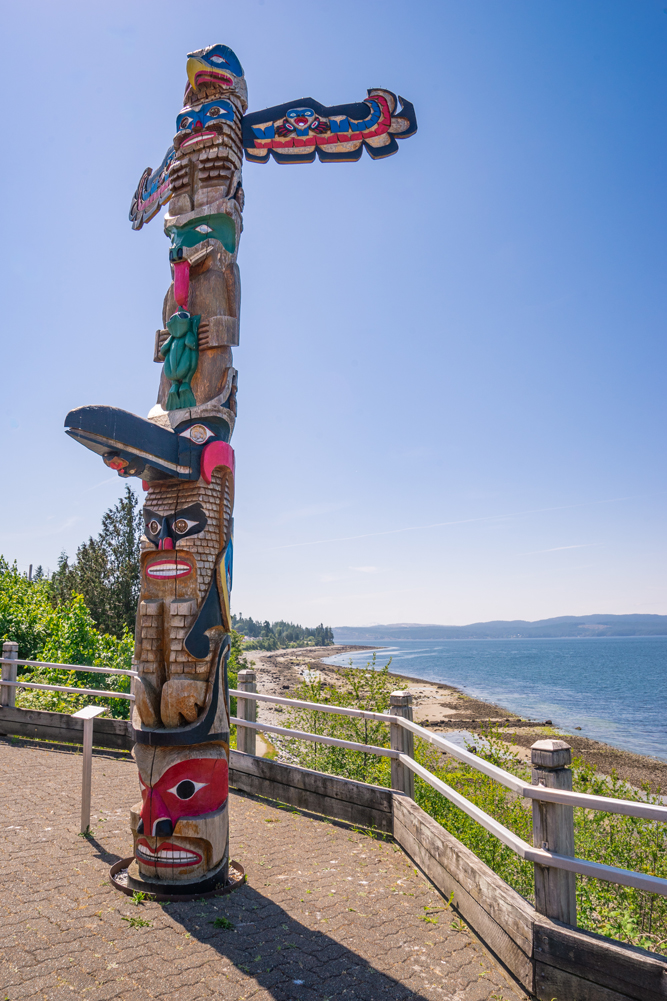
This totem pole stands at a viewpoint near Powell River, BC.
If you’d like to stick around and explore the Powell River area, there are plenty of accommodations to choose from.
If you have read this far I’ll remind you again to please comment below and tell me of ones you’ve seen that I need to go visit. I’ll update this post as I see more! Thanks!


